Case study / Retail
A gun shop that needed a customer database, not just a website.
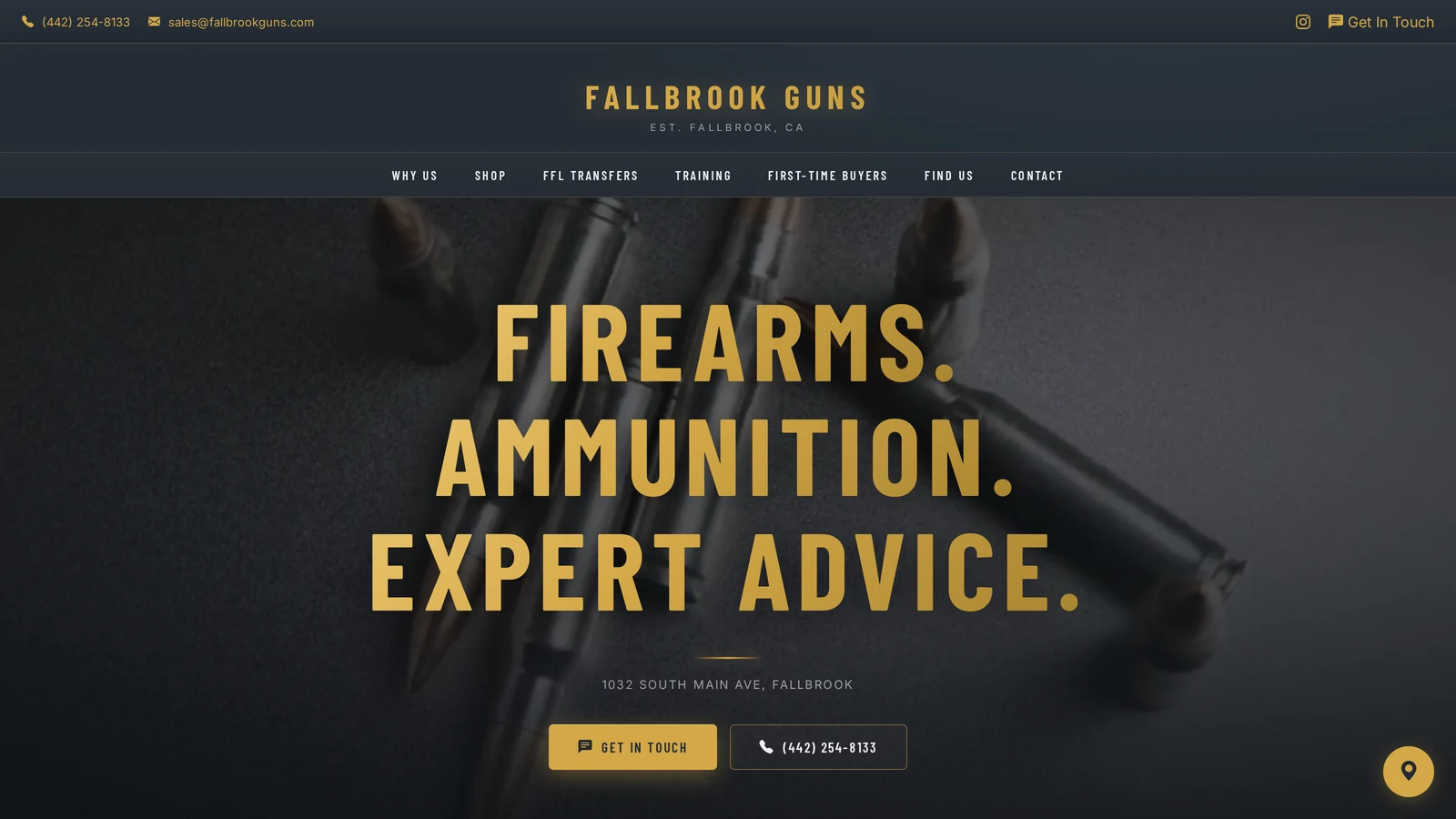
The situation
Fallbrook Guns is a storefront on South Main Avenue. Like most independent retailers, the business ran on the counter: people walked in, asked questions, bought something, and left. There was no way to reach them again, and no way for someone searching online for a specific service to find out the shop offered it.
Firearms retail also makes the usual playbook unavailable. Most mainstream email marketing platforms prohibit the category outright, so "just use Mailchimp" was never an option. Anything we built had to be permission-based and standards-compliant from the first line of code, or it would not send at all.
A website that answers real questions
People do not search for "gun shop." They search for the thing they need done. So the site is organised around services rather than products, with dedicated pages for FFL transfers, training, and first-time buyers, each with its own structured data so search engines can read what the shop actually does.
The contact form does something most small business sites get wrong: it fails honestly. If a submission does not reach the server, the visitor sees an error and the shop's phone number, instead of a fake success message that quietly loses the enquiry.
The part that isn't a website
Underneath the site sits a customer system built specifically for how this shop works. Enquiries from the website land in it automatically. Walk-in customers can be added at the counter. Transfers move through the stages a real FFL transfer actually has, from initial enquiry through the waiting period to ready-for-pickup, so nobody has to remember where a given customer is in the process.
Service pages
Separate, indexable pages for each service line, with schema and a sitemap.
Lead capture
Website enquiries flow straight into the customer record with the source attached.
Transfer tracking
Each customer sits at a clear stage, visible at a glance.
Counter sign-up
A printed QR code at the register puts customers on the list with explicit consent.
Email that is allowed to send
Because the category rules out the usual platforms, we built the sending infrastructure properly. Mail goes out from a dedicated subdomain with full authentication, so the shop's ordinary business email is never put at risk. New senders get throttled or blocked if they blast a cold list, so sending starts small and scales up over days rather than going out all at once.
Every message carries one-click unsubscribe. Bounces and complaints are removed from the list automatically, without anyone having to notice. Opens and clicks are tracked on our own servers rather than handed to a third party.
Cleaning the list before using it
The shop's point-of-sale system held several thousand customer records collected over years at the counter. Before any of it was used, we checked every address against live mail servers.
The list came back 99.2% deliverable. We repaired eleven addresses that had been mistyped at the register, common things like gmial and gamil, each one a real customer who would otherwise never have been reachable. Fifteen addresses at domains that no longer exist were suppressed so they can never be mailed.
Built to keep running
The system backs itself up nightly. A watchdog checks it every fifteen minutes and restarts it automatically if it stops responding. If the customer list has not been refreshed in a while, it says so. None of that is visible to the shop, which is the point.
Where it stands
The website is live. The customer database is live and holds the shop's full contact history. The sending platform is approved, authenticated, and cleared for volume. The counter sign-up is ready to print.
This is what we mean when we say we build more than a website. The site is the part customers see. The rest is the part that makes it worth having.
More case studies